Understanding Workplace Vibration Harm
Vibration is easy to overlook because you often cannot see it. But when a person is exposed to vibration repeatedly, the body has to absorb that energy. There are two main types of workplace vibration:
Hand-Arm Vibration (HAV) and Whole-Body Vibration (WBV).
They affect the body differently, so it is important to understand the difference.
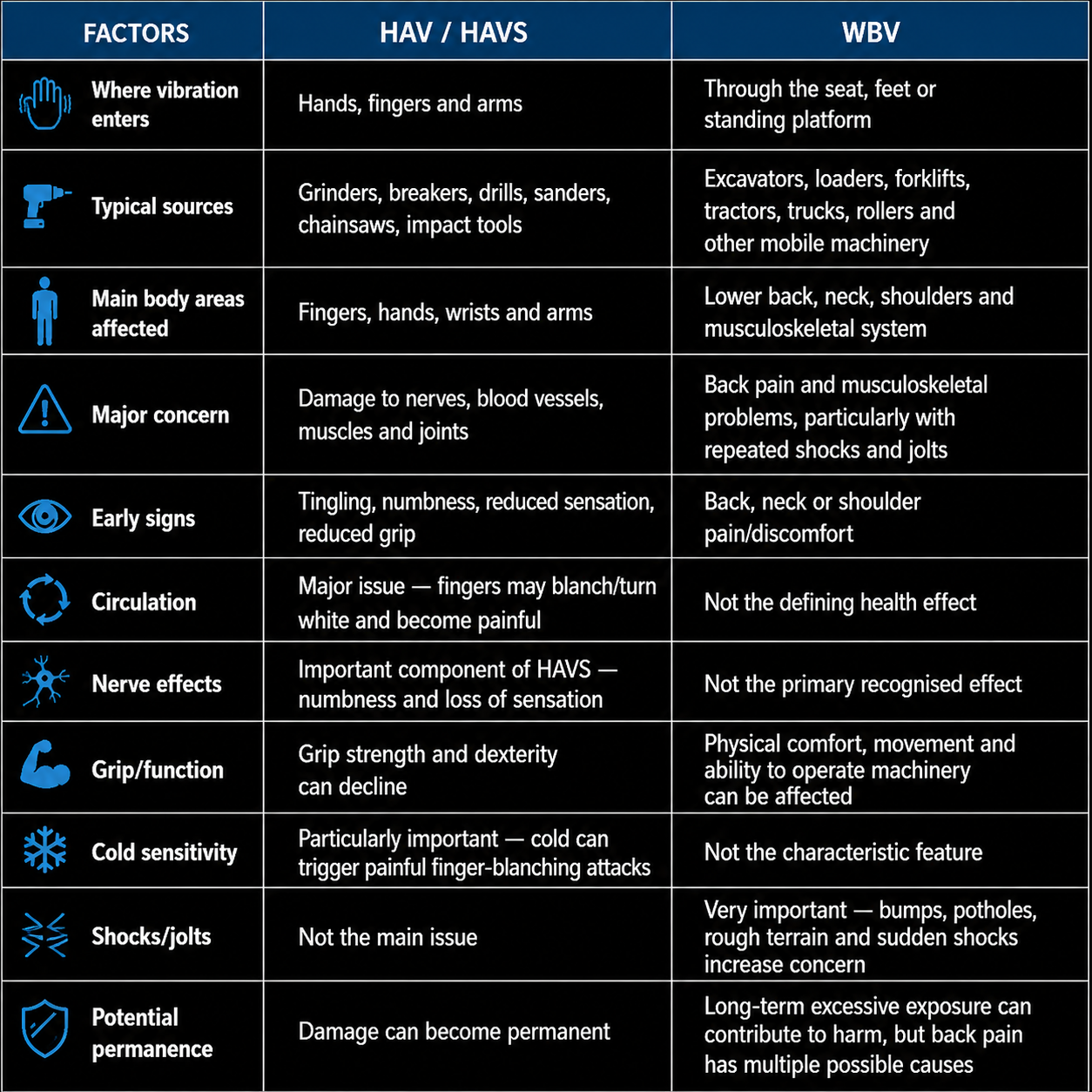
1. Where does the vibration enter the body?
Hand-Arm Vibration (HAVS)
With HAV, the vibration travels from a handheld tool through the hands, fingers and arms.
Think about using a grinder, breaker, drill, sander, chainsaw or impact tool. The worker is holding the source of the vibration, so their hands and arms receive the exposure.
Whole-Body Vibration (WBV)
With WBV, the vibration enters the body through a seat, feet or standing platform.
This is common when operating excavators, loaders, forklifts, tractors, trucks, rollers and other mobile machinery.
The important difference:
HAV starts at the hands. WBV is transmitted through the body.
2. What parts of the body can be affected?
HAVS can affect the:
Fingers
Hands
Wrists
Arms
Nerves
Blood vessels
Muscles
Joints
This is why prolonged exposure can eventually affect how well a person feels, grips and uses their hands.
WBV is primarily associated with the:
Lower back
Spine
Neck
Shoulders
Musculoskeletal system
Repeated vibration, particularly when combined with shocks and jolts, can contribute to back and musculoskeletal problems.
3. What might a worker notice first?
This is where understanding HAVS becomes important.
The early signs may be easy to dismiss:
Tingling → numbness → reduced sensation → reduced grip
A worker might simply think:
“My hands feel funny after using the tool.”
That can be an important signal that shouldn't be ignored.
Understanding WBV, a worker may instead notice:
Discomfort → stiffness → back, neck or shoulder pain
They may say:
“My back is always sore after operating that machine.”
Again, the symptom is information. It tells us we need to understand what is happening rather than simply accepting it as part of the job.
4. Why is circulation important with HAV?
This is one of the major differences between HAVS and WBV.
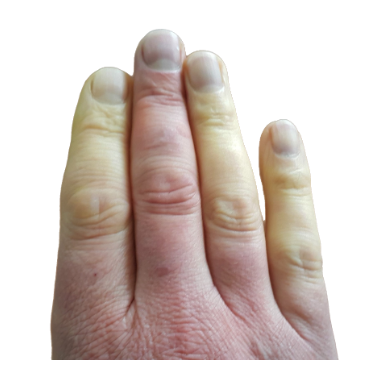
Repeated hand-arm vibration can affect the small blood vessels in the fingers.
Some workers can develop vibration white finger, see below image: where fingers become pale or white and may become numb or painful, particularly when exposed to cold.
So with HAV, we need to understand both:
the nervous system and the circulation.
5. What happens to the nerves?
The nerves in the hands allow a person to feel:
Temperature
Pressure
Touch
Movement
Texture
When nerve function is affected, sensation can be reduced.
That matters because losing sensation isn't simply uncomfortable.
It can affect a person's ability to:
feel → grip → control → manipulate → perform precise work.
Over time, this can affect both work and everyday activities.
6. Why are grip and dexterity important?
Imagine trying to use a tool when your fingers don't feel completely normal.
You may have less sensation.
Your grip may not be as strong.
Fine movements may become more difficult.
That is why vibration harm isn't simply about a vibration measurement.
It is ultimately about what that exposure means for the person experiencing it.
7. Why are shocks and jolts important with WBV?
With WBV, the vibration itself isn't the whole story.
Think about an operator driving over:
Rough ground
Potholes
Uneven surfaces
Construction sites
Rough haul roads
The worker can experience repeated shocks and jolts through the machine and seat.
That is why understanding the machine, operating conditions, route, seat, posture, duration and exposure is important when considering WBV.
8. Can the effects become permanent?
This is where we need to take vibration exposure seriously.
With HAVS, some damage can become permanent if exposure continues.
That means we shouldn't wait until symptoms become severe before asking questions.
With WBV, the situation is more complicated. Back pain has many possible causes, so we shouldn't automatically say vibration caused a particular person's back problem.
Instead, we should understand the total exposure and the other contributing factors.
That is a much more responsible way to approach workplace health.
9. And what about the person's wellbeing?
Vibration harm isn't necessarily limited to the physical symptom.
Persistent pain, discomfort or numbness can affect how a person:
works → sleeps → moves → performs → lives their everyday life.
This is particularly important with HAVS, where symptoms can affect work and activities outside work.
So when we talk about vibration, we shouldn't only ask:
“How much vibration was measured?”
We should also ask:
“What is this exposure doing to the person?”
The key lesson
HAVS and WBV are not the same.
HAVS affects the hands and arms.
Think nerves, circulation, sensation, grip and dexterity.
WBV affects the body.
Think back, musculoskeletal loading, posture, shocks and jolts.
But there is one principle that applies to both:
Don't wait for harm to become obvious before trying to understand the exposure.
Vibration may be invisible.
Its effects are not.
And that leads directly into the Workplace Intelligent philosophy:
See the exposure.
Understand what it means.
Understand who is affected.
Identify what matters most.
Then decide what should change.